

The Expiration Date of Memories, and a Vanishing Immigration History
The expiration date of our immigration history is passing. We must record it right now so that the fierce lives of the first generation remain as history, rather than being cast aside.
- The sweat and tears of the first generation of immigrants are not mere ‘tales of hardship,’ but precious ‘cultural heritage’ that must be recorded and preserved.
- Taking a lesson from the fierce archival spirit of the Jewish and Japanese communities, we must hasten to establish a systematic archiving system.
- Passion within the compatriot community alone has clear limits; policy support from the home government and the construction of an ‘Immigration Museum’—even a cyber one—are urgent.
Artifacts that fail to make it into a museum’s storage are often destined to be treated as trash. As I live here in Canada, my heart sinks every time I witness this simple yet cruel truth applying equally to immigrant society. Right now, our immigration history is passing its expiration date of memory.
I think about this every time I attend a funeral. It is not merely a person’s body that enters the coffin. Their desperate survival story in a strange land, the patience that endured discrimination, and the narrative of tears shed while raising children are all being buried in their entirety. The first generation of immigrants who crossed over to Germany, the Middle East, and here to North America in the 1960s and 70s are now exiting into the background of history. All that remains in their wake are a few faded photo albums and fragmentary episodes remembered by their children. It is a sad reality, but unrecorded memories do not become history; they degenerate into ‘legends’ or ‘unofficial folklore,’ or eventually scatter into the void.
Having directed events commemorating Korea-Canada diplomatic relations and published photo books of the community, I have confirmed just how dynamic and tearful a drama our immigration history is. The time spent by miners, nurses, or students who started with bare fists, staying up all night guarding the counters of dry cleaners and convenience stores, cannot be dismissed simply as ‘personal hardship.’ It was the priming water that pump-started South Korea’s economic development and the root of the global Korean network. Yet, we are neglecting this precious asset.
Let us look at other communities. The Jewish people recorded and collected testimonies with obsessive persistence to elevate the tragedy of the ‘Holocaust’ into a universal history of humanity. The Japanese-Canadian community also thoroughly archived the history of forced internment during World War II, building museums to silently educate future generations that "this must never happen again." To them, history is not a means of reminiscing about the past, but a weapon that guarantees future survival. On the other hand, what about us? Buried in superficial economic success, children’s admission to prestigious universities, or futile struggles for titles within community associations, we have neglected the work of creating a ‘genealogy’ that proves who we are and how we got here.
What is needed right now is Oral History and systematic data collection. One transcript of an elder lying in a hospital bed is a hundred times more valuable than erecting grandiose monuments or statues. We must digitize their vivid voices: why they left their homeland, how they overcame language barriers and racism in the early days of settlement, and with what heart they remitted dollars to their homeland during the IMF crisis. This holds tremendous value as anthropological research material as well.
However, speaking coldly, this massive undertaking cannot rely solely on the Sipsi-ilban (making a collective effort with small contributions) of the compatriot community. Local Korean associations or organizations are often financially poor, and business continuity is frequently broken when the leadership changes. ‘Recording’ is a realm that requires persistence, capital, and expertise. Therefore, I look forward to a shift in perception and active intervention from the home government, specifically relevant agencies like the Overseas Koreans Agency. How about investing even a fraction of the budget used for spreading pop culture like K-Pop or K-Drama into organizing the immigration history of overseas Koreans? I envision a ‘Cyber Immigration Museum’ that compiles the lives of 7.5 million overseas Koreans scattered around the world. We need a digital archive where compatriots from each country can upload and share their records beyond physical constraints, and where future generations can access and confirm their roots at any time. This will not merely be taxidermy of the past, but a powerful platform that emotionally binds the global Korean network.
If your grown children do not know their ‘father’s country’ and ‘the path grandfather walked,’ the Korean blood they possess will only be a source of identity confusion, not pride. The independence activist Shin Chae-ho said, “There is no future for a people who have forgotten their history.” Applying this quote to immigrant society is even more chilling: “An immigrant society that does not record its history will eventually vanish on the periphery of mainstream society.” We must move now so that the arduous yet fierce lives of the first generation remain as history, not oblivion; in a museum, not a trash can. We do not have much time left.
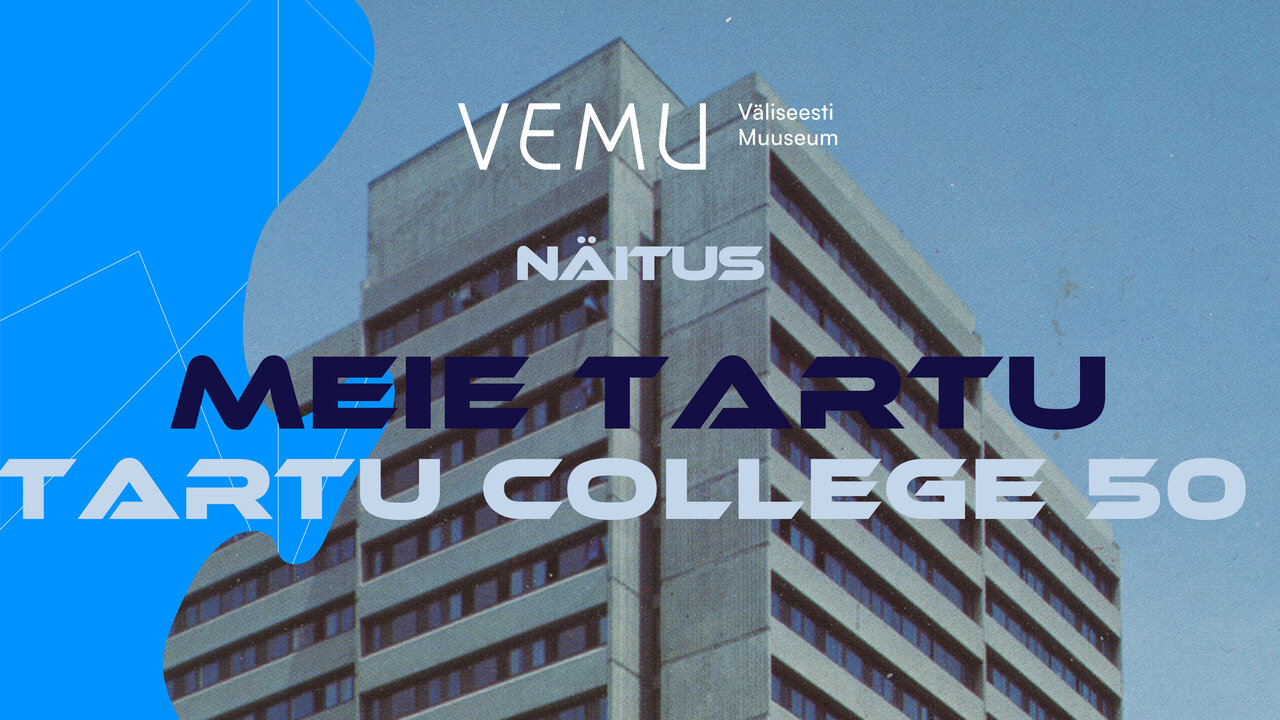
(Photo Caption) Poster for the "Tartu College 50th Anniversary" exhibition held at VEMU.
"VEMU" is the Museum of Estonians Abroad (Estonian Museum Canada) located in Tartu College, Toronto. It strives to preserve and share the history and culture of the Estonian diaspora. The history of Estonian immigration to Canada can be summarized as a process starting with a few pioneers in the late 19th century, followed by a large influx of refugees immediately after World War II, eventually establishing themselves as key members of Canadian society. As of 2026, the Estonian population in Canada is estimated to be over 24,000, which is one of the largest Estonian diaspora communities in the world.
(This content was created using generative AI, with partial edits and reviews by the administrator.)