

Beyond the Pacific, Beyond Rank
The diaspora grows stronger when we dismantle the walls of cliquishness.
- There is no future for the immigrant community in drinking glasses shared only to figure out who is the "older brother" and who is the "younger brother." Let us tear down the fortress of vertical hierarchy.
- Let us look to the mainstream society's horizontal partnerships, where people connect through "ability" and "vision" rather than age and graduation year.
- Respect does not stem from a forced hierarchy. True communication begins only when we discard outdated authoritarianism.
As people embark on their immigration journey and pack their bags, they leave behind their heavy titles and social networks from Korea. The various titles they held throughout their lives become mere history; in a new land, they aim to stand on an equal starting line as "immigrants." However, the landscape of the Korean community they encounter in this unfamiliar land strangely replicates—or even more rigidly entrenches—the most outdated aspects of the Korea they left behind.
The questions that fly at you right after exchanging names at a first meeting remain unchanged: "How old are you?", "Where is your hometown?", "Which university and what year did you enter?" These three questions are not rooted in simple curiosity. They are a ritual of "ranking" to determine whether to place the other person below you or serve them above you. Once verified, titles are instantly sorted into hyungnim (older brother) and dongsaeng (younger sibling), and from that moment on, rational debate disappears. When the older brother speaks, the younger must follow; as the senior leads, the junior must fill their glass. I would like to call this the "ghost of Korea's hierarchical culture." This outdated custom, which should have been rightfully tossed into the ocean as we crossed the Pacific, was stubbornly packed deep inside our immigration bags and unpacked once again here.
Such cronyism and vertical hierarchy are the greatest toxins hindering the harmony of immigrant society. Whenever I see the banners of "OO Alumni Association," "OO Hometown Association," or "OO Veterans Association" fluttering in our small Korean community, I feel dizzy. Of course, I understand the desire to seek out people from one's hometown or alumni to soothe the loneliness of living in a foreign land. However, when it goes beyond simple fellowship and becomes an exclusive "inner circle"—acting as a power that marginalizes those who cannot join—the community becomes divided. For the immigrant society to develop, we must move beyond the culture of "cliques" toward "diverse solidarity." To achieve this, we must deeply reflect on the examples of other ethnic groups in Canada.
Let us first look at the Jewish community. They are widely known for their strong horizontal debate culture. While rabbis and community elders exist, their authority does not come from age. It comes from wisdom and debate skills. "Chavrusa," the Jewish educational method, encourages young students to logically refute their teachers or fathers. This culture extends into adult society. In a business meeting or community council, it is not at all awkward for a young lawyer in their 20s to tell a wealthy sexagenarian, "Your opinion is wrong." They focus on "what" is being said rather than "who" is saying it. Thanks to this horizontal communication structure, information and capital flow smoothly through the Jewish community without generational disconnects, allowing them to respond agilely to external threats.
The same is true for the mainstream Canadian society, particularly in business settings driven by English and French Canadians. A Korean business owner once told me, "The countless Canadian partners I've met over 30 years operate strictly on a first-name basis." At first, I didn't know what that meant. It meant that a gray-haired director would call a 25-year-old intern, "Hey, John," while asking for his opinion, and that treating a subordinate poorly or making them run personal errands just because of an age difference was unimaginable. For them, "respect" is not an acknowledgment of "seniority," but of "professionalism." He added that organizations can be flexible and creative precisely because of this rational relationship dynamic.
In contrast, what is our reality? The fundamental reason why numerous Korean Canadian organizations are failing to attract fresh blood and are instead aging is precisely this "hierarchical culture." The 1.5 and 2nd generations, who grew up receiving public education in Canada, are accustomed to horizontal cultures at school and work. To them, Korean organizations are suffocating spaces. If they freely express an opinion during a meeting only to be scolded with, "You're young and don't know anything," or "How dare you talk back when a senior is speaking," they will never return to that organization.
First-generation immigrants often say they easily witness "painful scenes" within the community. Haven't we seen capable young people come in to showcase their talents, only to leave, fed up with the attitude of some older generations who force them to taste the "bitterness of the organization"? They have said, "Korean jeong (warmth/affection) is great, but I can't stand the Korean kkondae (condescending boomer) culture." This is more than a brain drain; it is akin to community suicide. The same goes for the arts and culture sector. Whenever performance experts direct major community events, they collaborate with various artists. At those times, the thing they are most wary of is people "calculating seniority." Art stems from a free spirit, but the moment people start calculating graduation years and entry cohorts, creativity suffocates. A senior director noted that the Canadian artists they met treated each other as "colleagues" regardless of age, which allowed their synergy to explode. Yet, even within community arts organizations that one would expect to operate most exemplarily, exhaustive scenes unfold as people still bicker over who is senior and who is junior, engaging in turf wars over performance orders or seating arrangements. Now, we must make a decision. We must boldly cast away Korea's hierarchical culture. There is no reason to cling to Korea's negative customs while living in Canada.
First, let's change our titles. Instead of hyungnim, sajangnim (boss), or hoejangnim (president), we can attach "-nim" or "-ssi" to each other's names, or simply use English names. When titles shed their authority, the emotional walls come down. I saw a Korean startup meetup establish a rule to call each other by English nicknames without asking for ages, and amazing ideas and collaborations emerged there.
Second, we must create a culture that respects "roles" rather than "age." If a Korean association president in their 30s is elected, community members in their 60s and 70s must honor and follow them as the leader of the organization. The moment someone clicks their tongue and says, "They're young enough to be my child," the organization walks the path of decline. We must not merely pay lip service to the phrase "age is just a number"; we must show it through action. Experienced seniors are most beautiful when they remain in the positions of "advisors" or "mentors" quietly offering support from behind, rather than acting as commanding "superiors."
Third, we must dismantle cronyism and aim for an "open network." Alumni or hometown associations should be restricted to private gatherings, and asking about one's university or hometown should be made a taboo within public Korean organizations or business associations. Instead, we should ask, "What kind of work do you do?" and "What vision do you have?" A community expands when it shares future values rather than past connections.
Fourth, we must establish a democratic decision-making structure. Operations where the so-called "group leader" decides and notifies others on a whim no longer work. Even if it takes time, we must go through the process of debate and consensus. That is the fundamental democracy Canadian society has taught us.
Immigrants are "transplanted trees." Though our roots may have been left in Korea, our branches and leaves must grow bathed in Canada's sunlight and wind. However, if we insist only on the soil clinging to our roots (Korea's hierarchical culture) and reject the soil here (a horizontal culture), the tree will inevitably wither or grow deformed. I hope our sons, daughters, and future generations will remember the Korean community not as an "authoritarian and stifling place," but as a "rational and dynamic place." For that to happen, the generation currently holding vested power must change first. Instead of seeking to be served, they must seek to serve. Instead of seeking to teach, they must seek to learn.
If you are in Toronto, you might as well bury the heavy burdens we brought from Korea—like a sense of entitlement, saving face, and hierarchy—deep into Lake Ontario. When we face each other "person to person" with lighter shoulders and open minds, the true power of the "Korean Diaspora" will finally be unleashed. If you have a gathering this evening, try putting this into practice. Instead of asking for someone's age, ask about their dreams. That small change will make our immigrant society dance.
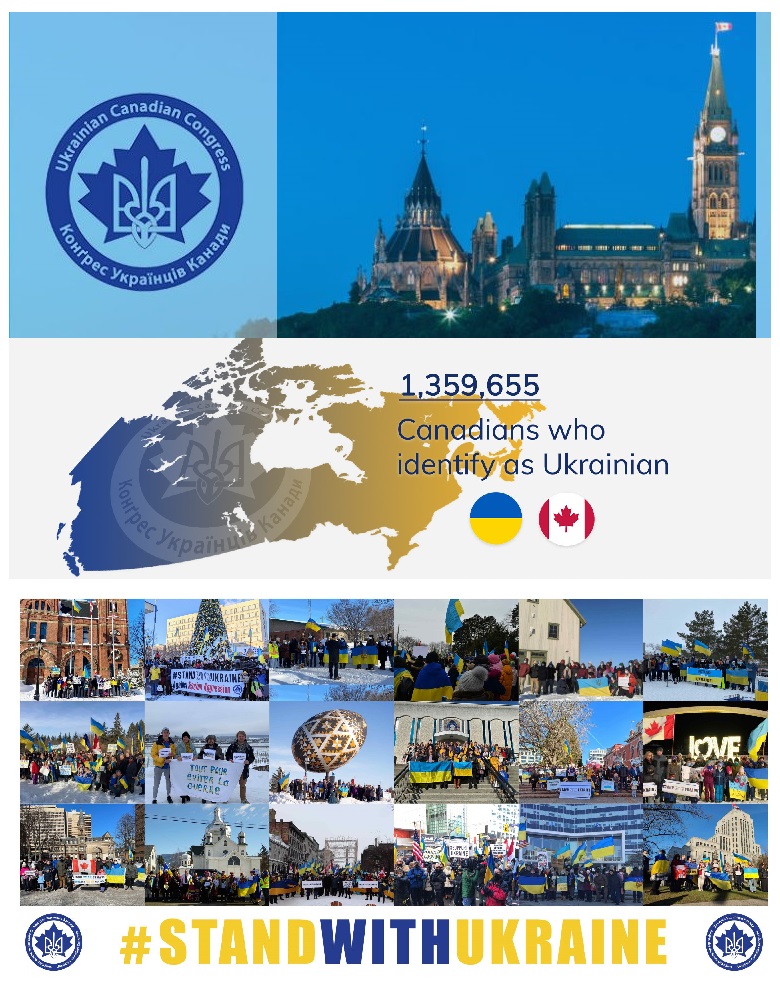
Ukrainian Canadian Congress (UCC) Homepage
It states the immigrant population as "1,359,655 Canadians who identify as Ukrainian." The photo below shows a rally held on February 6, 2022, in Ottawa, Ontario, where 30 communities from 10 provinces came together in support of the Ukrainian people fighting against Russian aggression, urging the Canadian government to provide immediate defensive weapons to Ukraine.
Ukrainian Canadian Congress (UCC)
Founded in 1940, this organization represents one of Canada's largest ethnic communities (1.4 million people). It has led, coordinated, and represented their interests, while also playing a crucial role in shaping Canada's social, economic, and political landscape. Far from a simple social club, it is a "powerful lobbying group" and a "community control tower" that directly influences the Canadian federal government's foreign and immigration policies. They moved the Canadian government to become the first in the world to recognize their homeland's independence, helped design Canada's multiculturalism policies, and currently serve as highly systematic civilian diplomats assisting war refugees.
The UCC cites the following as its three proudest achievements: ① "Making Canada the first country to recognize Ukraine's independence" (1991), ② "Changing Canada's national policy" (establishing Multiculturalism), ③ "Recording tragedy in history" (recognition of the Holodomor genocide and its inclusion in Canadian school curricula).
In particular, the core operations of the UCC Toronto Branch include: ① Government lobbying and policy proposals, ② War refugee settlement and emergency relief, ③ Nurturing and educating next-generation leaders. Notably, they collaborate with the Toronto District School Board (TDSB) to run Ukrainian language programs in public schools, and they teach language and history to second- and third-generation youths through weekend schools. The goal goes beyond merely teaching the language; it is to raise children who will grow up to enter mainstream Canadian society (politics, law, finance) as talented individuals who never forget their roots.
(This content was created using generative AI, with partial edits and reviews by the administrator.)