
The Weight of a Single Faded Photograph, Tucked Away in a Closet
A single faded photograph in the closet holds the heavy weight of an immigrant's life. Because what is forgotten cannot become history, now is the time to turn your trivial records into a great legacy before they vanish.
- Small Personal Records Gather to Form a Great Immigrant History… Now is the ‘Primetime’
- The ‘Korean-Canadian Cyber Museum’ is an open museum… Awaiting a small miracle
- Remember: What is forgotten cannot become history. Only those who record possess history.
It is not an exaggeration to say that an immigrant's life is a continuous cycle of ‘packing’ and ‘unpacking.’ Immigrants can never forget the weight of their lives pressed into a few suitcases when they first left their home country for a strange new land. Since then, standing at the crossroads of choice through several moves—deciding constantly what to discard and what to keep—there are always items that are the most difficult to deal with, yet impossible to throw away. These are the moldy photo albums and letters turned yellow with age, tucked deep inside the closet. Children may scold us, saying, "Just scan them and keep them as digital files," but within those items lies a physical memory that digital formats can never replace. Today, I want to talk about how this ‘troublesome’ clutter is actually historical material that our immigrant society must protect at all costs.
Over the past 25 years, traveling between Canada and the United States, I have met many fellow Koreans. While organizing various events, big and small, and directing programs, there is one thing I have felt keenly: the ‘absence of records.’ We were too busy. We had no leisure to look back as we struggled to take root in a strange land, make a living, and educate our children. The standard for a so-called ‘successful immigrant’ was judged solely by a decent house, a nice car, and whether the children got into prestigious universities or entered professional fields. In that process, the records containing our sweat and tears, as well as our moments of failure and frustration, were overshadowed by the ‘myth of success’ and headed for the trash can.
What is history? The Grand Narratives left by those in power are not the only history. From the perspective of Micro-history, a grease-stained menu from a restaurant in the Bloor Street Koreatown of the 1970s is a more vivid piece of immigrant history than a government diplomatic document. A weekly pay stub received by a former miner upon first arriving in Canada; a tear-stained airmail letter sent by a nurse mother to her family in Korea; notes scribbled on the back of a ramen packet boiled and eaten during days as an international student. These are not merely items for selling nostalgia. They are anthropological reports proving how we survived and adapted while maintaining our identity as Koreans in a barren foreign land.
The problem is that now is the ‘Primetime.’ The first generation of immigrants, the so-called ‘Old-timers,’ are passing away one by one. The precious materials they have kept in their closets all their lives may be discarded en masse during the sorting of their belongings. To second and third-generation immigrants who do not know the Korean language, a parent's diary or old photographs might appear to be nothing more than paper waste covered in unintelligible characters. If these are thrown away, it could become a cultural disaster for the entire Korean community. We should feel a sense of shame when we look at the Jewish community or Japanese-Canadians, who persistently collect the history of their persecution and settlement to build museums and use them as places of education for future generations. They exist because they record, while we may be disappearing because we forget.
A physical brick-and-mortar museum requires an enormous budget and maintenance costs. Moreover, considering the unsavory disturbances that occasionally arise within the community and the various organizations that are often too focused on "show-off" events, the construction of an offline museum has a high probability of becoming a "white elephant" from the start. Therefore, I propose the construction of a ‘Korean-Canadian Cyber Museum’ as a realistic and immediate alternative.
The term ‘Cyber’ refers to a computer world where information is exchanged and shared, mainly through communication environments like the Internet. A Cyber Museum can be seen as a form of human imagination realized. It is a new type of museum that shares materials and diverse information users want via the Internet using multimedia technology. Although it has been called by various names—Internet museum, digital museum, e-museum, online museum, hyper museum, web museum, virtual museum—they all refer to a ‘Cyber Museum’ with similar functions. A Digital Archive has great advantages: it can store artifacts indefinitely, can be viewed by users anywhere in the world at any time, and digital data can be copied infinitely without loss, preserving it regardless of physical lifespan. In other words, a Cyber Museum is a futuristic museum that realizes the concept of an open museum for "anyone, anytime, anywhere."
An early settler in Vancouver could view the records of an international student in Montreal, and a second-generation Korean in Toronto could hear the voice of a grandfather in Halifax. This is not simply about building a website. It is the work of weaving together scattered individual memories using Digital Archiving technology to create a foundation of searchable and shareable ‘collective intelligence.’ As such, a Cyber Museum has no constraints of time or space.
To achieve this, a pan-community material donation campaign must come first. We do not need grand treasures. Photos of a picnic hosted by the Korean Association in the 1980s, early Korean language school textbooks, a catalog from a closed video rental store, a collection of church bulletins—anything that shows the lifestyle of that time is a target for donation. We need to open the closet doors of every home. The Korean community media must report on this campaign with sincerity, and academic experts must analyze the context of the collected materials to clothe them in storytelling. The Overseas Koreans Agency, a Korean government body, should also pay attention to projects excavating these basic historical materials, rather than focusing solely on supporting flashy events like K-Pop concerts or business conventions. That is the basis of a true policy for overseas Koreans.
Opinion leaders in the immigrant society must also contemplate the qualitative maturity of the community. Buying a meal for others is not the entirety of leadership. The role of a true leader is to encourage the leaving of a spiritual legacy so that descendants can feel, "Ah, our grandfathers and grandmothers lived life this fiercely."
I respectfully ask those reading this column to search through your closets during a spare moment. Face the younger version of yourself in those faded black-and-white photos, wearing unfashionable clothes and a stiff expression. That single photo likely contains the fear and excitement of a strange land, and a solemn resolve to protect your family. That weight is by no means light. Your trivial memories gather to turn into the massive stream of our immigrant history. Let’s write even just one line on the back of the photo—the date, the place, and your feelings at that time. And let’s prepare to share it. Let us not leave our history in the hands of others, but record and preserve it ourselves. That is the way to maintain the dignity of Koreans in this mosaic society, and it is the greatest legacy we can pass on to our sons and daughters who have grown up so well.
What is forgotten cannot become history. Only those who record possess history.
Let us keep this in mind, and wait for a small miracle.
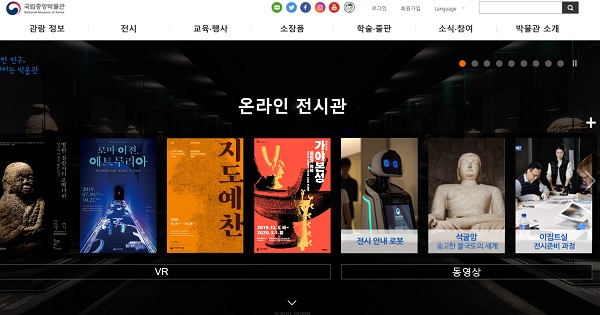
(Photo Caption) The Cyber Museum of the National Museum of Korea, where various artifacts can be viewed in high resolution.
A Cyber Museum is a futuristic museum that realizes the concept of an open museum accessible "anytime, anywhere, and to anyone." It is a new type of museum that shares materials and diverse information desired by users via the Internet using multimedia technology. Although it has been referred to by various names such as Internet museum, digital museum, e-museum, online museum, hyper museum, web museum, and virtual museum, these terms all point to the ‘cyber museum,’ which shares similar functions. Digital archives offer major advantages: they can store artifacts without limit, allow users from all corners of the globe to view them, and allow for preservation regardless of physical lifespan since digital data can be copied infinitely.
(This content was created using generative AI, with partial edits and reviews by the administrator.)